Wise vs Revolut (2026): Which One You Actually Need.
Revolut sells the interbank rate as a monthly allowance, not a rate. Wise charges from 0.23% and no subscription. Here is the window where Revolut wins.
- Wise has no monthly plan. 31 USD once for account details in 22 currencies, then from 0.23% on what you convert. Holding money and receiving local payments are free.
- Revolut Business has no free tier in the US any more. The cheapest plan is Basic at from $10 a month, and it includes zero fee-free international transfers.
- Revolut's "interbank rate" is a monthly allowance, not a rate: $1,000 on Basic, $20,000 on Grow, $80,000 on Scale. Over it you pay 0.6%, or 1% outside market hours.
- 0.6% is roughly double what Wise quoted me on a real USD to EUR transfer, which came out at 0.296% all in.
- Grow ($40/mo, $20,000 allowance) is cheaper than Wise between about $13,000 and $28,000 converted a month. Scale ($140/mo, $80,000) between about $47,000 and $112,000.
- Convert $5,000 a month and Wise costs about $16. Revolut Basic costs $10 for a $1,000 allowance, so you pay the subscription and the 0.6% on the other $4,000.
- Neither is a bank. Wise is an MSB registered with FinCEN, not FDIC insured. Revolut Business US is a prepaid card program issued by Lead Bank, Member FDIC.
The question that decides Wise vs Revolut
Ask what you want the account to be responsible for. Wise is responsible for a rate. Revolut is responsible for a team's spending. Both will hold your euros and both will issue you a card, so the overlap is real, but they are priced by two different theories of what a business account is and that is what makes the choice easy once you see it.
Wise sells you infrastructure and charges you per use. There is no plan, no tier, no minimum balance, and no month in which you owe them anything for having an account open. You pay 31 USD once to get account details in 22 currencies, and after that you pay a percentage of whatever you convert.
Revolut sells you a plan, and the plan contains an allowance. That distinction is the entire article and almost nobody writes it down, because Revolut's headline feature is "exchange at the interbank rate" and the interbank rate sounds like a rate. It is not. It is a monthly quota measured in dollars, and when you have used it up you go back to paying a percentage like everyone else. I keep this stack's brands on Wise and I have run the numbers against Revolut twice now, because the second version of the plan page made me think I had got it wrong the first time.
Revolut's interbank rate is an allowance, not a rate
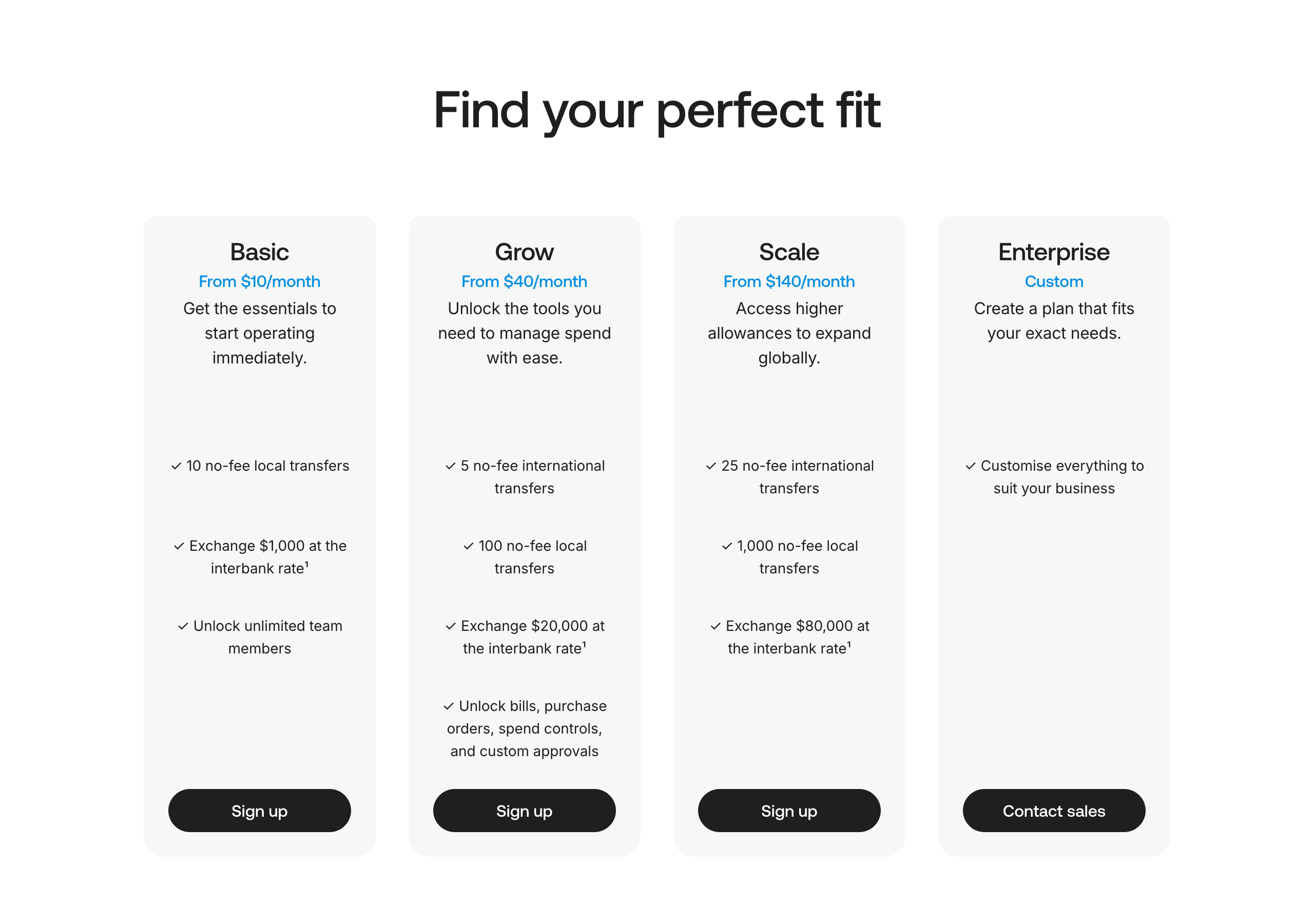
Here is what Revolut's own plan page said on 27 August 2026, in US dollars. Basic starts at $10 a month and includes $1,000 of exchange at the interbank rate. Grow starts at $40 and includes $20,000. Scale starts at $140 and includes $80,000. Enterprise is a phone call.
Past the allowance, Revolut charges 0.6%. Convert outside market hours and it is 1%. Both numbers are printed in the small text under the row, not on the card you actually read, which is a fair place to put them and a very quiet one.
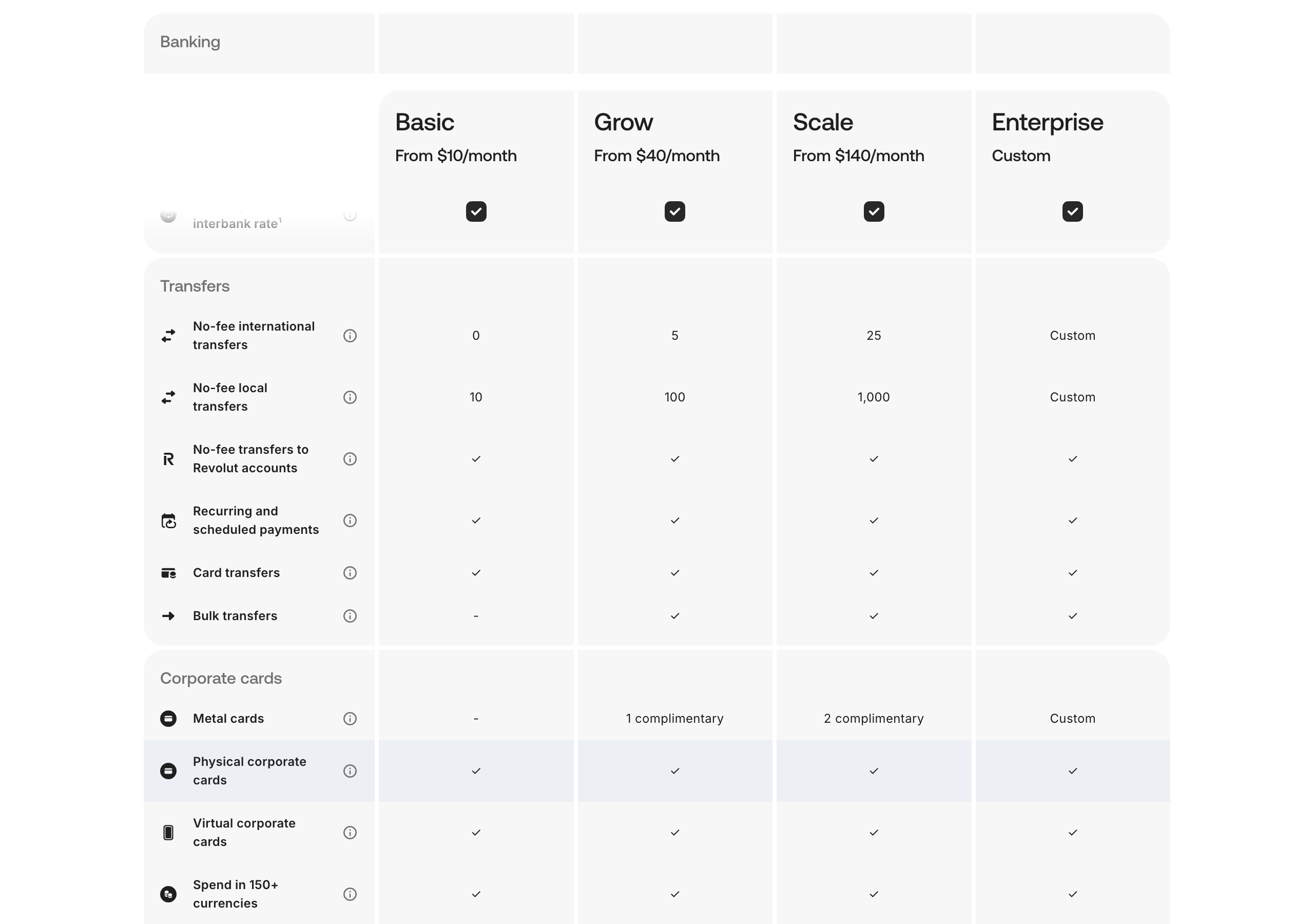
The other thing that changed and that most comparison pages have not caught up with: there is no free Revolut Business tier in the US any more. Our own database still had Revolut down as "Free Basic, Grow $30/mo" this morning, which was two versions of the pricing page ago. Basic now costs money, and what it buys is thinner than it looks. Ten fee-free local transfers. Zero fee-free international transfers, so every cross-border payment is $5 on top of the subscription. No bulk transfers. No metal card. The $1,000 exchange allowance would cover roughly one invoice.
None of this is a trick. It is a normal software business charging for software, and the spend controls behind the paywall are genuinely good. But if you came to Revolut because you read that it gives you the interbank rate, you should know you are buying a fixed block of currency at a fixed price, and that the price of the block only makes sense at certain sizes.
| Option | Price | One-line call | Who it's for |
|---|---|---|---|
| Wise Business | 31 USD once, then from 0.23% | You pay for money moved, not months elapsed. | Anyone converting under about $13,000 a month |
| Revolut Grow | From $40/mo | $20,000 of FX included, then 0.6%. | $13,000 to $28,000 converted a month |
| Revolut Scale | From $140/mo | $80,000 included, plus card customisation. | $47,000 to $112,000 converted a month |
| Revolut Basic | From $10/mo | $1,000 of FX and no free international transfers. | Teams who want the cards, not the rate |
| Both | 31 USD + $40/mo | Wise moves the money, Revolut holds the cards. | A team spending abroad on someone else's budget |
What Wise charges, in the only numbers that matter
Wise publishes one fee list and it fits on a screen. Registering is free. Getting account details in 22 currencies is 31 USD, once. Holding money in your account is free. Receiving domestic payments in AUD, CAD, EUR, GBP, HUF, NZD, PHP, SGD and USD is free. Sending and converting start from 0.23% and vary by currency. Spending on the card in a currency you already hold is free.
The two fees people trip over are the ones worth knowing before you open it. Receiving a USD wire or a Swift payment costs 6.11 USD per payment, which matters if your clients' finance departments only know how to send wires. And ATM withdrawals are free up to 250 USD a calendar month, then 1.95 USD plus 1.95% each, which is bad enough that you should treat the Wise card as a card and not as a way to get cash.
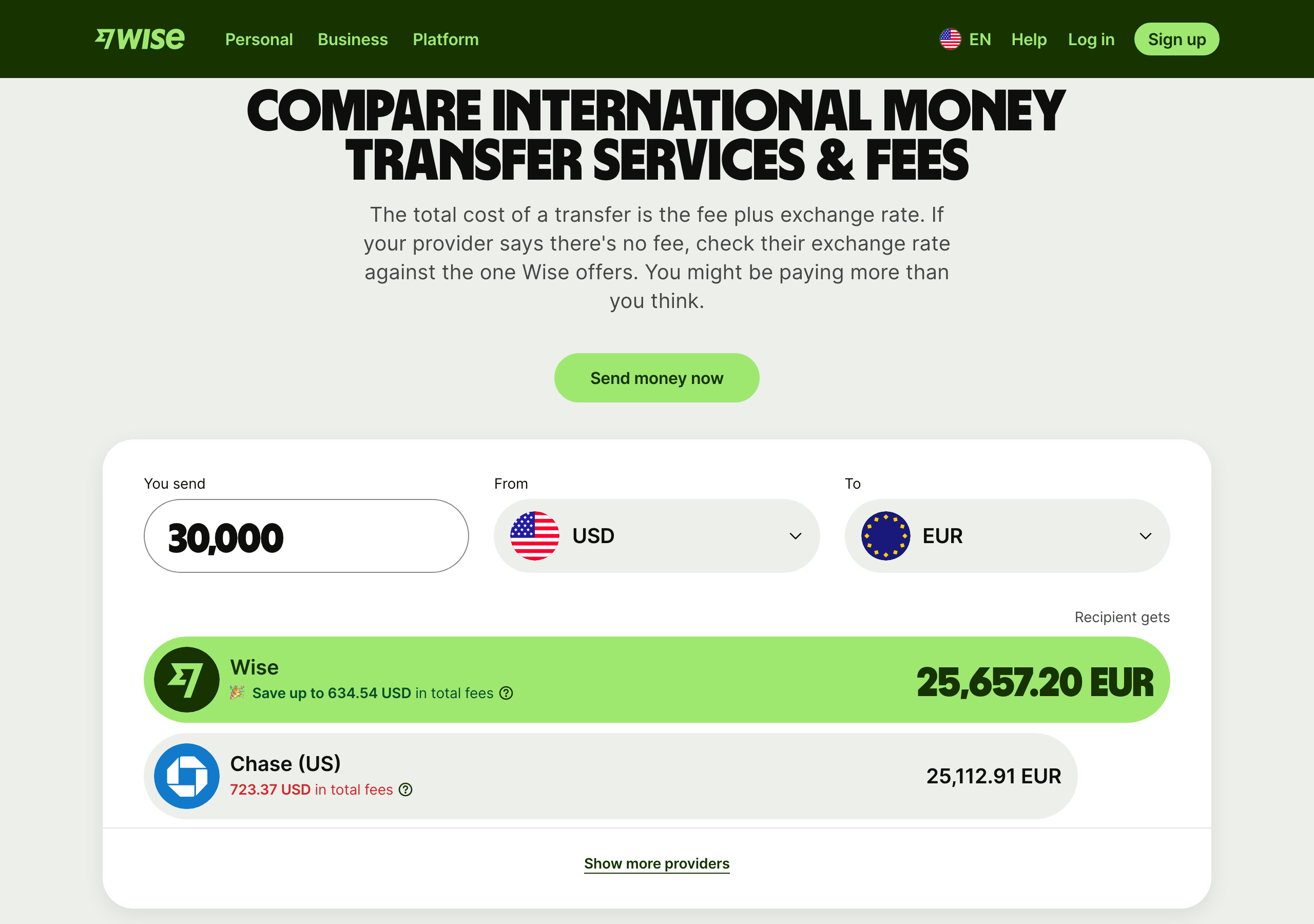
Percentages are slippery, so I priced a real transfer rather than quoting the floor. On 27 August 2026 I put 30,000 USD to euros through Wise's own comparison tool. Total fees: 88.83 USD, including a 4.91 USD volume discount that kicks in over 25,000 USD. That is 0.296% all in, and the recipient gets 25,657.20 EUR. The same 30,000 through Chase, on the same screen: 723.37 USD in fees, because the markup lives inside the exchange rate where you cannot see it. (Wise built that comparison to sell you Wise, so treat the framing with the usual suspicion. The Wise column is still a real quote I could have clicked through and paid.)
Hold that 0.296% next to Revolut's 0.6% over-allowance fee. Once the allowance is gone, Revolut is charging you about double what Wise charges for the same job. That is the shape of the whole comparison: Revolut is cheaper up to a line and more expensive after it, and the line moves with your plan.

The window where Revolut Grow actually wins
Take the plan price and divide it by what Wise would have charged. That tells you the monthly conversion volume at which the subscription starts paying for itself.
Grow costs $40 and includes $20,000. Below 25,000 USD there is no volume discount, so Wise runs about 0.3125% on this corridor. $40 divided by 0.003125 is $12,800. Convert less than that and Wise is cheaper. Convert between $12,800 and $20,000 and Grow is cheaper, by up to $22 a month at the top of the allowance.
Then the window closes from the other side. Past $20,000, Revolut charges 0.6% on the excess while Wise stays around 0.3%, so Revolut's lead shrinks with every extra dollar and is gone by about $27,800. So Grow's real window is roughly $13,000 to $28,000 of currency converted a month. Outside it, on both sides, you are better off on Wise.
Scale runs the same way, one order of magnitude up. $140 a month against Wise's discounted 0.296% breaks even at about $47,000 converted, and the 0.6% over-allowance fee gives the advantage back at about $112,000. Basic never wins on rate at all: $10 buys you $1,000 of exchange, and Wise would have charged roughly $3.13 for that same $1,000.
Two things about these numbers, and I would rather say them than have you find out. They are FX cost only, so they ignore everything else a plan includes. And they use a USD to EUR corridor, which is one of the cheapest Wise runs. Send to a currency with a wider spread and Wise's percentage climbs, which pushes every break-even point down and moves the window in Revolut's favour. Price your own corridor before you decide. It takes two minutes on Wise's calculator and you will get an exact number instead of my rounded one.
What Revolut does that Wise does not
Everything above is one axis, and if it were the only axis nobody would pay Revolut. They do, and the reason is that Revolut Business is a spend-management product that happens to bank, which is a different thing to buy than a rate.
From Grow up you get bills pulled out of your accounting software, purchase orders matched against them, custom approval rules, and per-account permissions. Every plan, including Basic, gets unlimited team members at no extra cost, which is a genuinely unusual pricing decision in a category that loves a per-seat charge. Grow includes one complimentary metal card and Scale two, with extras at $49. Card controls let you set limits by category, currency and period, so the intern's card works at the AWS bill and nowhere else.
Wise does not pretend to compete here, and this is the part where I have to be straight rather than loyal. Wise Business gives you team cards and syncs to your accounting software, and that is where it stops. There is no approval chain. There is no purchase order object. If four people are spending company money and someone has to chase receipts every month, Wise makes you do that chasing somewhere else, in a spreadsheet or in a tool you pay for separately, and after a while that costs more than $40.
So the honest reading is that they are not really the same purchase. If you want the cheapest way to move money across a border, that is Wise and the arithmetic is not close for most people. If you want to stop being the person who reconciles other people's card spending, that is Revolut, and the FX allowance is a rebate on a product you were buying anyway. Plenty of businesses end up running both, and there is nothing embarrassing about that: Wise for the money, Revolut for the cards, one 31 USD fee and one subscription that earns its place.
One more thing neither company leads with. Neither is a bank. Wise is a Money Service Business registered with FinCEN and is not FDIC insured, with the card program run through sponsor banks. Revolut Business in the US is a prepaid card program issued by Lead Bank, Member FDIC. Both disclose it in the footer of the pages I screenshotted for this piece. If you are holding a serious operating balance, that is worth ten minutes of your attention and a real bank for the float.
The call
Open Wise. It costs 31 USD once, it charges you nothing in a quiet month, and at the volumes most solo founders and small teams actually run it is the cheaper of the two by a clear margin. Add Revolut Grow the month your currency conversion sits reliably above about $13,000, or the month a second person starts spending company money and you notice you are the receipts department. Skip Basic. It is $10 for a $1,000 allowance and no fee-free international transfers, which is a card product wearing a rate product's clothes.
Wise holds the finances slot in the 22-tool stack for this reason, and the wider business account review covers the parts this page skips, including what happens when a client will only pay by wire. If you want to know what you are already paying for money movement before you change anything, the method in the subscription audit finds it in about an hour.
Wise is the one to open, because it charges you for the money you actually move and nothing for the months you move none. One 31 USD fee gets account details in 22 currencies, there is no plan to pick, and a real 30,000 USD to euro transfer I priced on 27 August 2026 cost 88.83 USD in total fees. Revolut Business is the better buy in one specific band: if you convert somewhere between about $13,000 and $28,000 of currency a month, its $40 Grow plan beats Wise's percentage, and if you also need corporate cards with approval rules behind them, it beats Wise at a job Wise does not really do. Outside that band the subscription costs more than the fees it replaces, in both directions.
Honest FAQ
Is Wise or Revolut better for a business?
Wise for most solo founders and small teams, because there is no monthly plan and you pay only on the money you convert. Revolut once you are converting more than about $13,000 a month, or once you need corporate cards with approval rules and purchase orders behind them, which Wise does not offer at all. Below that line the Revolut subscription costs more than the fees it is replacing.
How much does Revolut Business cost in 2026?
There is no free tier in the US. Basic starts at $10 a month, Grow at $40, Scale at $140, and Enterprise is custom, as printed on Revolut's plan page on 27 August 2026. Each plan includes a monthly interbank exchange allowance of $1,000, $20,000 and $80,000 respectively. Basic includes zero fee-free international transfers, so each one costs $5 on top of the subscription.
What does Wise charge for a business account?
31 USD once for account details in 22 currencies, and no monthly subscription after that. Sending and converting start from 0.23% and vary by currency. Holding money is free, receiving domestic payments in nine currencies is free, and receiving a USD wire or Swift payment is 6.11 USD. A real 30,000 USD to euro transfer priced on 27 August 2026 cost 88.83 USD in total, which is 0.296%.
Does Revolut really give you the interbank rate?
Up to a monthly allowance, then no. The allowance is $1,000 a month on Basic, $20,000 on Grow and $80,000 on Scale. Convert more than that in a month and Revolut charges 0.6%, or 1% outside market hours. That 0.6% is roughly double what Wise charged on a real USD to euro transfer, so the interbank rate is best understood as a fixed block of currency included in the plan price.
At what point is Revolut cheaper than Wise?
Grow is cheaper between roughly $13,000 and $28,000 of currency converted a month, and Scale between roughly $47,000 and $112,000. Below the lower figure the subscription costs more than Wise's percentage. Above the upper one, Revolut's 0.6% over-allowance fee has given the advantage back. These are FX costs only on a USD to euro corridor, so price your own currencies before deciding.
Can you use Wise and Revolut together?
Yes, and for a team spending abroad it is often the right answer. Wise moves and converts the money at the lower rate, Revolut issues the corporate cards and carries the spend controls, bills and approval rules that Wise has never built. That costs 31 USD once plus one Revolut subscription, and it beats forcing either tool to do the job the other one is actually built for.